 Large-format records
GroundGlass
A complete record of every frame you make.
GroundGlass is a large format and film photography record tool from the studio. It helps you keep the whole process of a shoot — from first idea and exposure to development — complete and clear.
By ArgentGlass Lab · iOS
Why we made it
Large format photography is never point-and-shoot. Each frame usually involves long observation, precise metering, deliberate camera movements, and the development and review that follow. What matters is not only the final negative, but the whole process behind that image.
Yet these details are easily lost: a notebook is never quite complete, phone notes don't line up with the film holders, and by the time you develop, you can no longer recall the exposure decisions you made. GroundGlass exists to solve exactly this — so every shoot can be recorded in full, as a working archive you can revisit, compare and build on.
It comes from real large format practice, and is made for anyone who takes each exposure just as seriously.
What it is
GroundGlass is not a simple parameter memo. It is a shooting workbench organised around one idea: a complete record of the work.
In one place you can:
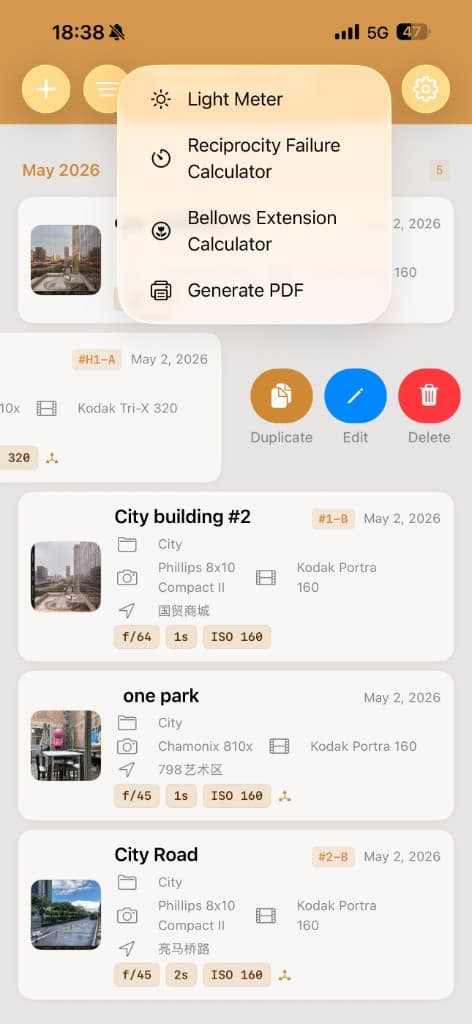
- Record every shot in detail
- Assist exposure and optical calculations in the field
- Manage gear, film and holder status
- Organise projects, development notes and archives
From the decision made at the ground glass to the developing in the darkroom, the flow stays continuous and the information stays whole.
Core capabilities
A complete shooting record
Build a clear archive for every exposure. You can record and organise:
- Basics: title, date, location, notes and project
- Camera settings: aperture, shutter, focal length, filters, film type and related parameters
- Zone metering: metering and exposure judgement in the spirit of the Ansel Adams Zone System
- Camera movements: tilt, swing and other adjustments unique to large format
- Development: notes on development and subsequent processing
Filter and sort by date, project, camera or film, with search and adjustable list density, so you can find a particular shoot within a large body of records.
Calculation and judgement throughout the shoot
A record is not only filled in afterwards; decisions in the field matter just as much. GroundGlass offers a set of tools close to the way large format actually works:
- Reciprocity failure: correction times for long exposures, based on common film data
- Metering and exposure reference: quick help with exposure judgement
- Exposure compensation: adjust for filters and changing conditions
- Bellows extension: compensation for close-up and extension
- Depth of field: near limit, far limit and hyperfocal reference
- Tilt and swing: help understanding and applying movements
The point of these tools is to help you think through the key factors before releasing the shutter, and to write the result you settle on straight into the record.
Gear and materials
A complete archive depends on a clear grasp of gear and materials:
- Manage cameras, lenses, filters and film
- Build projects and record templates to reduce repetitive entry
- Track holder status: empty / loaded / exposed / developed
- Holder reminders and a widget to avoid the wrong sheet, long-unshot holders or missed development
So what you used and what you shot always line up.
Pre-shot checklist
Large format has many steps and is easy to slip up on. A built-in, customisable pre-shot checklist — dark cloth, focus check, stop down, cock the shutter, insert and pull the darkslide, and so on — helps you verify the key actions before they matter, so a rare frame isn't lost to an oversight.
Development, review and archiving
Records serve not only the moment, but what comes after:
- Batch development marking and development information
- Map view of shooting locations
- PDF export (labels / summaries) for printing, filing and sharing
- Share cards that turn the key details of a shoot into something you can pass on
- Backup and restore to protect a long-built archive
When you look back at an image, you should be able to see the judgement, conditions and path behind it at the same time.
Design principles
Complete, not fragmented
The key information around a shoot is gathered into a single record and a single flow, as much as possible.
Close to real shooting
Features are organised around the actual habits of large format and film photography, rather than carrying a digital workflow over unchanged.
Quiet, in service of the work
The interface is restrained and doesn't compete for attention. Data is stored on your device; it collects no personal information and tracks no usage. Export and backup stay in your hands.
Available now
The features are free at this stage. It is, first of all, a product the studio wants to refine with care, and hopes will genuinely help the people who make pictures.
Who it's for
- Photographers who use large format cameras and take each exposure seriously
- Film photographers who need to keep their shooting and development process for the long term
- People who work in projects and want to build a personal image archive
- Studios, teaching and practice settings that need a consistent record of the shooting process
If you care not only about getting the shot, but about keeping every frame in full — GroundGlass is made for that.
Negatives preserve the image; records preserve the process. GroundGlass helps you keep a complete record of every frame you make.
Download on the App Store